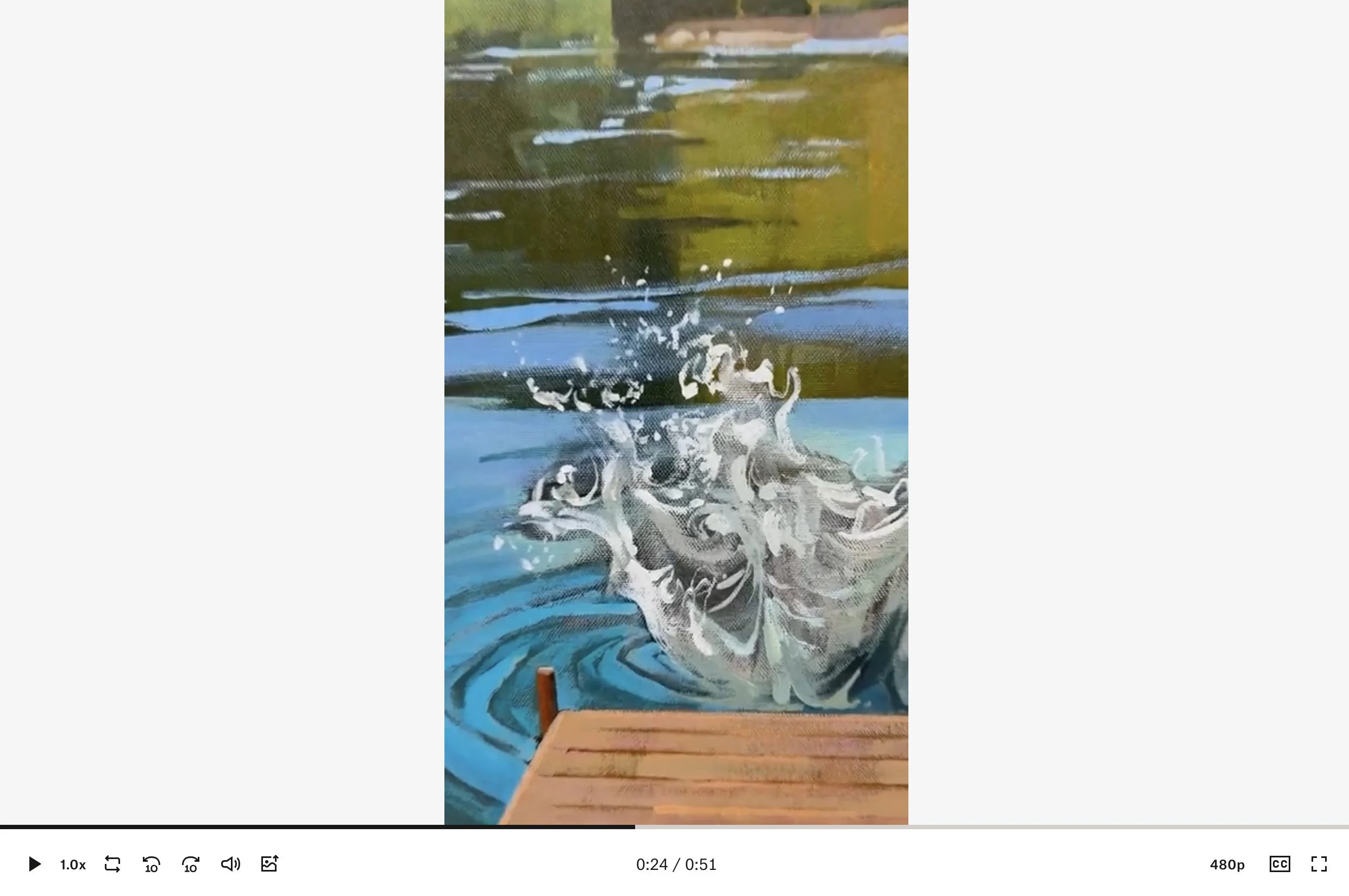
On the Water, In the Woods
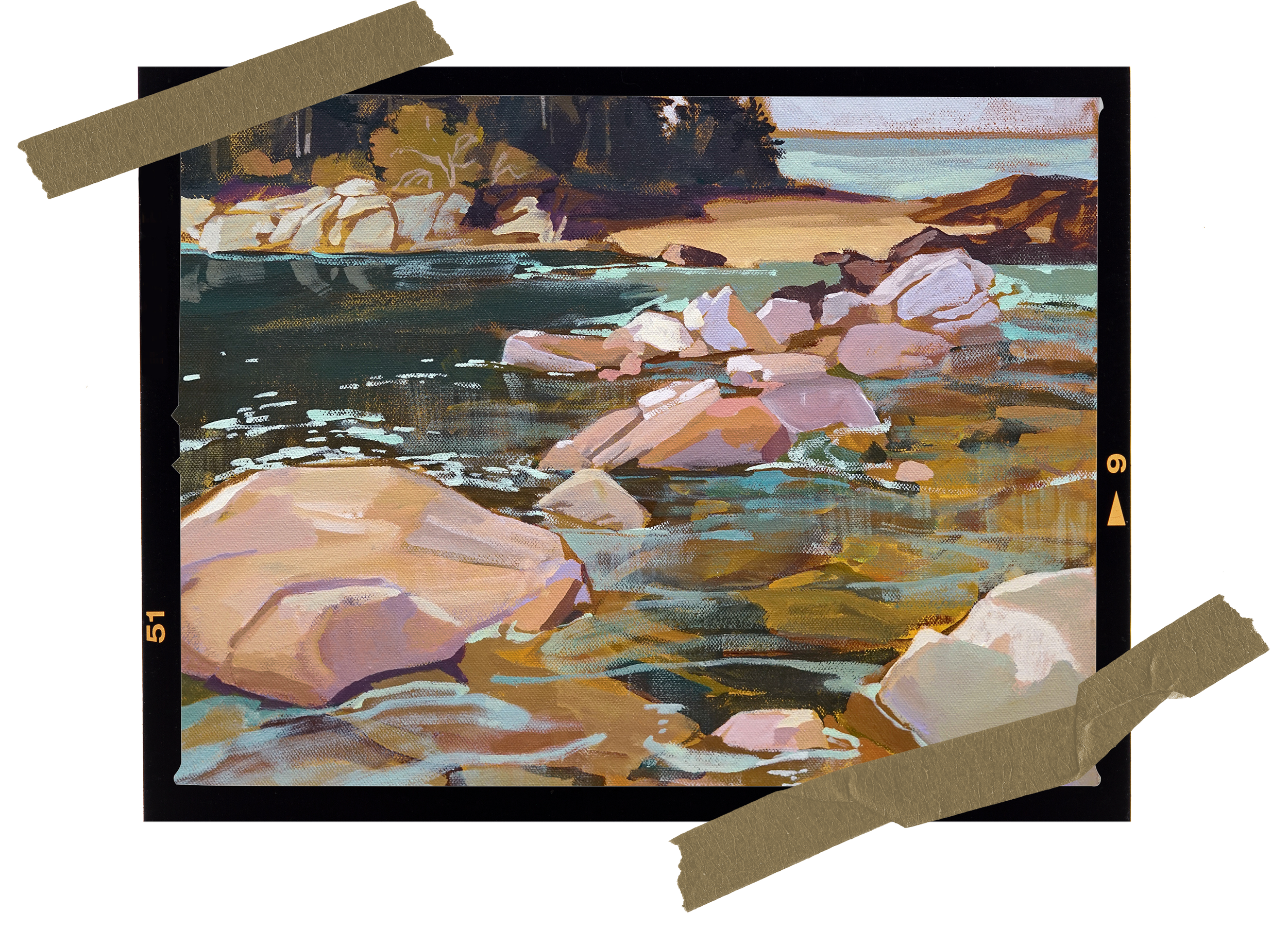
You know that meme where Homer Simpson recedes into a hedge? That’s me in the month of July. I say “no” to most invitations. I’m not managing school-year logistics. I take morning AND evening walks or bike rides. And I post way less online. It’s my birthday month, so I think there’s a tinge of “it’s my party” to it all. But what all of this intentional emptying really does is give me a solid month to paint my annual smalls collection, which later becomes the calendar. During the rest of the year, each time I have to pull myself out of the painting brain space, I also have to haul myself back into it later. But in July, I can just stay there, in my own little world, which means I paint more, and better, because each thought is able to build on the next one. It’s like finally being able to complete a full conversation with another adult when your toddlers have grown into teenagers. It’s exhilarating.
By the end of July, I had 15 pieces in varying stages of completion, and a rejected 16th that I’ll finish some day or paint over completely. A June vacation had provided ample inspiration, and August’s realities gave a nice little deadline for completion.
In June we had stayed in Rangeley, Maine, on a mountainside and then a lake peninsula (in exchange for a commission—I’m definitely onto something with that little arrangement!). I’d never been to that part of Maine, and it was remote in the best possible way. What is it about being in the woods? And why, the older I get, do I want to be farther into them? I’ve come to believe that it’s because the trees are not trying to sell me anything. Unlike much of our modern world, trees do not exist to take from you. They literally give you air to breathe. Nothing on the interweb comes close to that. A walk in the woods never fails to pour life back into me when so much else seems to drain it.

Fittingly, while in Rangeley, I was reading “My Neck of the Woods” by Louise Dickinson Rich. Her most well-known book, “We Took to the Woods” is a favorite, and I’d finally found some time to read this sequel I’d picked up at a thrift shop. Her books are full of her adventures in remote living, and really weave together a love letter to the land. About halfway through, I saw some familiar lake names, and realized all these stories were written in the area I was currently vacationing in. Yeah, I don’t know how I missed that. I was literally walking in her woods and driving around her mountains. I knew exactly where lakes “Mooselookmeguntic” and “Umbagog” were. When I found her book “Happy the Land” downtown later that week, I snatched it up. It’s named for the proverb, “Happy the land that has no history.” The idea is that the ordinary, peaceful places aren’t often in history books because there’s less geo-political importance there for them to record. (For perspective, she’s writing this just after WWII). But as she found, those out-of-the-spotlight places are rich in personal meaning, alive in the memory of the humans who live there. Maybe not important to anyone else, but everything to the ones who know them.
So are the memories these paintings represent. As I talked about in my last note, life is lived in specifics, and in those moments of joy these paintings bask. So the majority of the pieces in this series will have titles pulled from her writing. It only seems fitting. And also one will be titled “Linger Longer.” Maine camps often have witty names, and I saw one with this placard and fell in love with how it glides over your tongue and into your soul (other favorites include “Breaking Wind” on a breezy lake point and “Marsh Mellow” on an ocean inlet). I hope you, along with me, can manage to linger a bit longer in these last days of summer. And then I hope you might collect a painting next week to keep that memory alive the rest of the year.